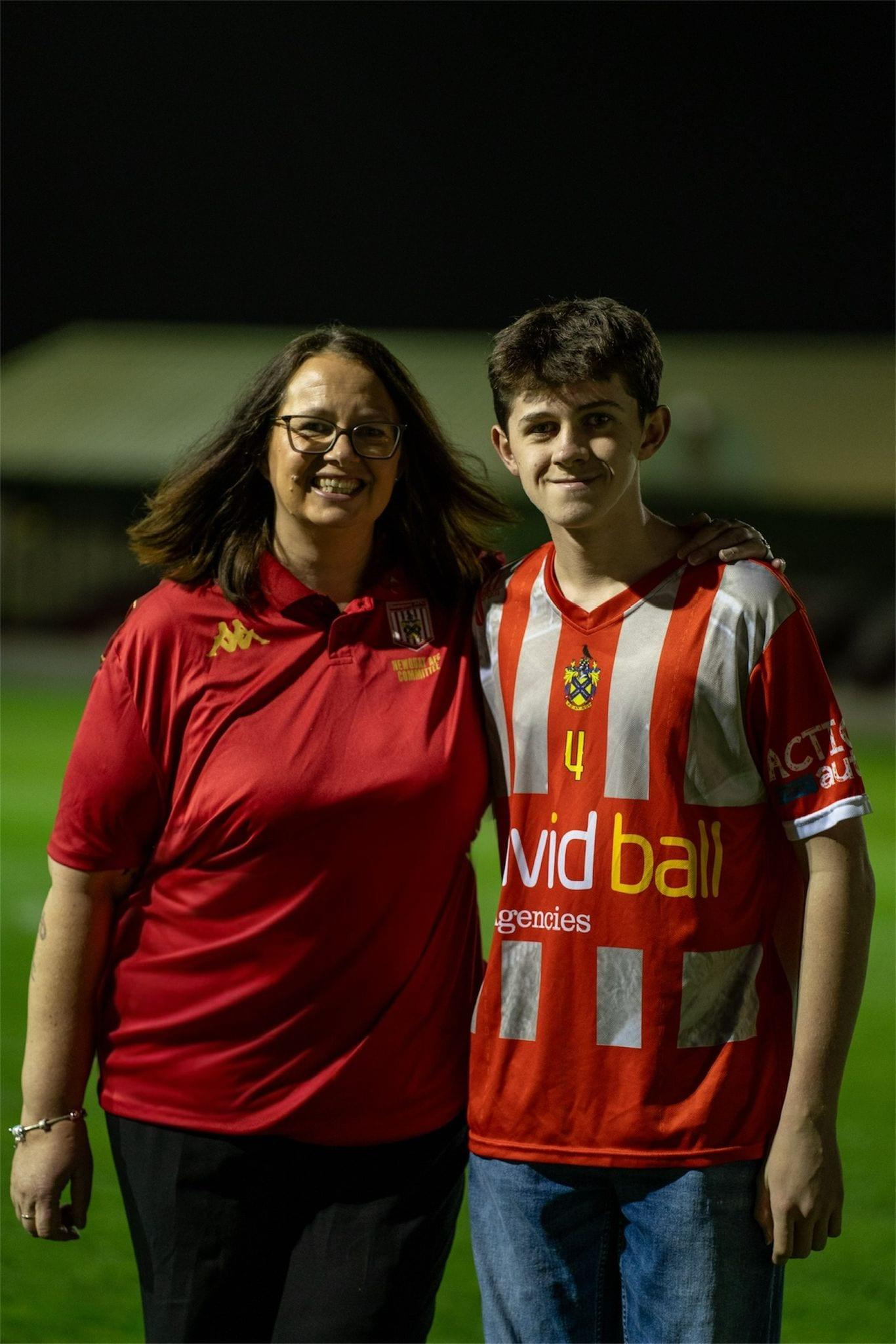
Emma Wright
More Than a Football Club
Emma Wright started volunteering at Newquay AFC after coming through cancer treatment in the middle of the pandemic. She had been diagnosed with breast cancer in 2020, and once the worst of both COVID and the treatment had passed, she wanted to be out among people again, making something of what she described as a second chance.
Her family were already on the committee. She started helping out in the canteen on match days, making teas and coffees and Bovrils and sausage rolls, getting to know the supporters, and loving every minute of it. Her day job is mostly working from home, so the canteen was where she got her face-to-face fix every week.
When WAX took over the bar and catering side, Emma stepped back from the canteen and went looking for something else to do at the club. Tom Moran, the treasurer, approached her about safeguarding. It linked to the work she does in her day job, so she said yes. Once she got into it, she realised that alongside the mandatory safeguarding work, the policies and procedures and risk assessments that have to be in place, there was room to build something bigger.
That something is the player welfare programme.
A Team Is a Group of People
"When I started thinking about welfare, it came off the back of conversations I'd had with other people at the club," Emma says. "Although we have all these teams of players, they come together to play football, but outside of that game they are all individuals living their own lives. They all have their ups and their downs. We see them pulling on a Newquay shirt, and we know them as a player who plays for our club, but outside of that they are people."
It is a simple starting point, and Emma comes back to it more than once during our conversation.
"You have to nurture the people that make up those teams. If we don't get that part right, that could affect how the team works together, how they play for each other, how they respond when they're injured or when they're not selected, how they show up to training. It's so much more complicated than just putting players together and getting them to stick on a shirt and run out on the pitch every Saturday afternoon."
Physical and Mental, Hand in Hand
The programme covers both physical and mental wellbeing.
"We're all super aware of our physical health," Emma says. "If we get out of bed in the morning and we've got a headache, or our arm is hurting for some reason, we check in on ourselves. But we don't always do that as much when it comes to mental health, and sometimes we leave it too long to pick up on a problem."
The physical side has been there for years, with the physios and the rehab and the work it takes to get an injured player back to match fitness. The mental side is newer, and that is where most of Emma's energy is going at the moment.
This season, the club is bringing in accredited mental health trainers to upskill the committee. Charlotte Dickin, founder of PorthBlue Consultancy and a Mental Health First Aid England instructor for both adults and youth, is partnering the club to put a programme together for committee members, coaches and volunteers. The point is that more people across the club know what to look for when something is going on, and feel comfortable enough to say something.
Emma has also been linking up with local organisations who already do brilliant work in this space. Man Down, who run male-orientated mental health support sessions. George's Voice, a charity focused on women's mental health. Bring in the experts, let them talk to the people who need to hear it, and they will land it better than anyone at the club could.
"People like Man Down resonate so much better with certain groups than if it was me trying to deliver everything myself."
What Welfare Looks Like in Practice
Most of what Emma does happens quietly. There is a welfare noticeboard in the changing rooms that she updates monthly, picking a theme or an awareness month, putting up posters and information and helpline numbers. Players and coaches see it every time they come in to change.
Last April was Testicular Cancer Awareness Month. Emma sourced helpline cards, business-card sized, and put one in front of every player's shorts before a home game. The line on the card was light and direct: have you checked your balls, are your balls match fit. Young men sit in the highest-risk bracket for testicular cancer, and a card on a folded shirt does the job better than a leaflet ever would.
Middsy and Ross Fallens were behind the idea from the start, which made it easy. Emma also put the same resources in the away changing room that day for the visiting team, Helston.
"Newquay is seen as a place that looks after its own. But I want us to be talked about as a club that really gets it, and that promotes welfare across all contacts. Whether that's our own teams or visiting teams."
Alongside the visible stuff, there is one-to-one work that nobody hears about. Conversations with players or coaches who want to talk something through with someone confidential.
"I hope nobody needs to call me. But I want to be there to offer it if that's the right thing for somebody."
She is comfortable with the fact that a lot of the impact is invisible.
"With a lot of what I do, you don't always know how it lands. You don't know whether someone has read something on the noticeboard and gone home and made a phone call to an organisation I've signposted them to. Just because you don't get feedback, doesn't mean things aren't happening. That's part of the role, and that's what I love about it."
Why Now
Asked why welfare matters more now than it did five or ten years ago, Emma goes back further than that. Her dad played for Newquay in the 1970s.
"You'd roll up, you'd play your game, you'd go for a few pints afterwards, and that would be it. The club atmosphere was there, the pride in pulling on the shirt was there, but the stuff that happens behind the scenes now wasn't. That probably just goes with the times. It wasn't so easy for men especially to talk about feeling low, or having anxiety, or financial problems."
The world has changed, and a responsible club has to change with it. There is also the fact that we ask a lot of our players. They turn up to training and matches having held down jobs, looked after families, and dealt with everything else life throws at them in between. The club can't pretend none of that is happening.
"Doing what we did before, and not offering what we didn't offer then, wasn't wrong. Times change. We've got to move with them."
Where It's Going
When asked what the programme could look like in two or three years, Emma keeps using the same word: equitable.
Last season, most of her work was based around the teams playing out of Mount Wise, which meant the first team and the Reserves got more direct support than the teams based at Godolphin. She wants to put that right this season.
"I really want to make sure we're working towards an equitable offering across all our senior teams. Whether you play for the firsts, the Reserves, the Thirds, the Ladies, the Veterans, you should have access to the same support and the same information."
She also wants to grow the support offering for volunteers, who she describes as too important to the club to be overlooked. And further down the line, she has an idea she has picked up from watching what other clubs are doing.
"Wrexham have done some brilliant stuff around groups that meet up before matches. People who might be going through something. Real, open mental health conversations over a pint, in a safe space, before the game. That's something I'd love to get off the ground at Newquay in the next couple of years. A pre-match support group. Welfare isn't just for the players. It's for everyone connected to the club."
Her ambition is for everyone to feel they have a part to play.
"My name might be on the officer list, but everybody can play a really important role in welfare. The more we talk about it, the more it grows."
A Note for Local Businesses
Charlotte Dickin partnering the club on mental health training is one example of what the programme needs to keep growing: people with expertise willing to put it behind the club.
"If there is anybody out there who is an expert in this field, or has a qualification, or teaches this kind of stuff, we'd love to hear from you. We're a bigger group of volunteers and committee members than we were a few years ago, but we can't do everything. If you think you've got something you can help us with, we would love a conversation."
The same applies to businesses thinking about how they support the club more broadly. Welfare is one strand of how NAFC is being built, and it sits alongside the work the rest of the committee is doing with sponsors and partners across the club.
If your business wants to be part of any of it, get in touch: [email protected]
Carrying On the Tradition
Emma's connection to Newquay AFC runs deeper than her current role. Her dad played for the club in the 1970s. Her uncle Mike Stern played too, and is up on the history boards in the clubhouse as one of Cornwall's best players of his era. Her mum sat on the old ladies' committee back in the day.
"For me it's about carrying on that tradition, but doing something where I can use my skill set. We've got a bunch of volunteers who are all bringing different skills to the table, and we're creating something good together."
She finishes with a typically Emma line.
"We didn't win Club of the Year at the Cornwall FA Awards this year. I'd really like us to win it next year."
She and the rest of the volunteers aren't looking for recognition. But they'll get it anyway, because the work is that good.
Up the Mints